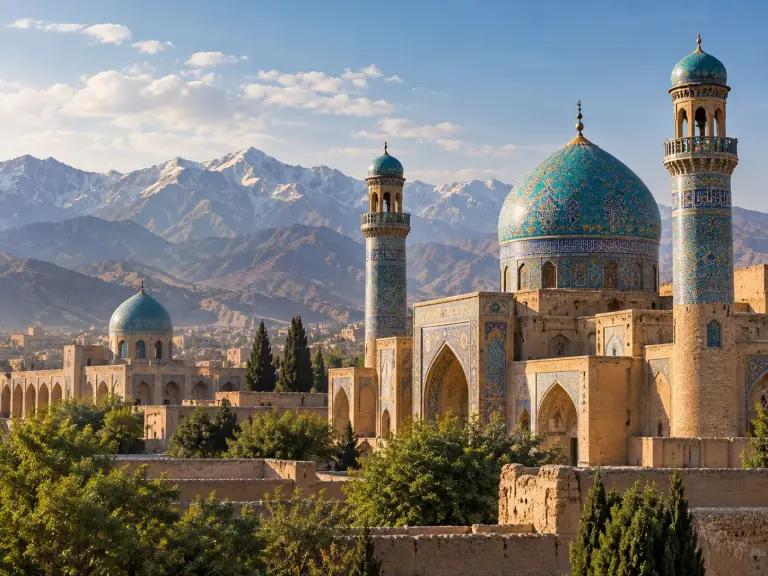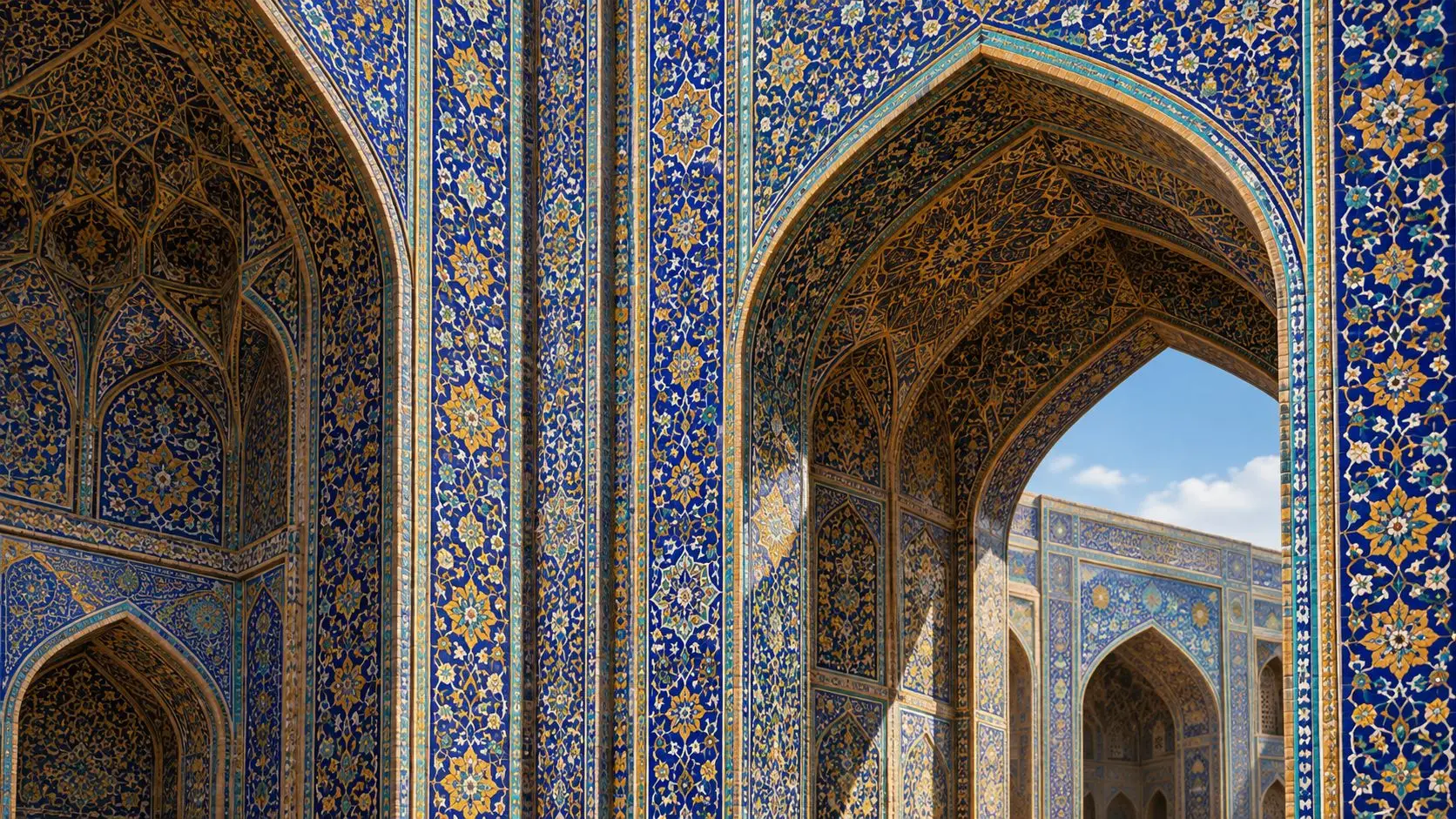
Seen from a distance, Herat’s great monuments announce themselves in colour: a ribbed dome glowing above a drum of glazed script, a lone minaret still wrapped in a lattice of tile, a mosque portal so densely patterned that it looks woven rather than built. Glazed tile has been the city’s signature for more than five centuries. Unusually, it is also a living craft. In the courtyard of Herat’s Friday Mosque, tile-makers still cut and set coloured pieces by hand to keep the old surfaces whole.
A Timurid renaissance
Herat lies in the fertile plain of the Hari Rud and has been a centre of trade, learning and art for much of its history. After destruction in the Mongol era, the city revived under the Timurids. UNESCO’s description of Herat credits Timur’s son Shah Rukh with launching an extensive building programme, followed in the 15th century by the works of his wife, Queen Gawhar Shad, which produced a remarkable ensemble of monuments in the Timurid style.
Shah Rukh, who reigned from 1409 to 1447, commissioned tilework for the citadel, Qala-e Ikhtiyaruddin, and it can still be seen on several of its towers. North of the walled town, along a new Timurid avenue, members of the court raised colleges, mosques and tombs: Gawhar Shad’s mosque and madrasa (1417–37), the madrasa of Sultan Husayn Bayqara (1477–86) and the Ikhlasiya complex of the poet and statesman Mir Ali Shir Navai, begun in 1475–76. The Bayqara madrasa became part of the ensemble later known as the Musalla.
This was also a city of calligraphers, painters and musicians. UNESCO names the painter Behzad, the poet Jami and the Sufi master Ansari among the figures associated with Herat. It is easy to see the city’s tiled walls as cousins of the manuscript page: framed, bordered and filled with script and ornament.
How a tiled wall is made
Timurid builders used several techniques, often on the same building. The most demanding was tile mosaic (moʿarraq), which the Aga Khan Trust for Culture (AKTC) singles out as some of the finest work of the period. Tiles glazed in a single colour were cut into small shapes, and the pieces were fitted together into intricate floral and geometric designs. Plaster bonded the fragments into larger panels, which could then be fixed to walls or to curved surfaces such as squinches and domes.
For broad expanses of wall there was a quicker method, known as bannaʾi, in which glazed brick-like tiles ornament the surface. Builders also used painted tiles in the haft-rangi (‘seven-colour’) or cuerda seca technique, and tiles painted under the glaze, although Encyclopaedia Iranica notes that on Gawhar Shad’s mosque in Mashhad these were less common than mosaic.
Individual architects had recognisable habits. Qavam al-Din of Shiraz, who built Gawhar Shad’s mosque and madrasa in Herat over some twenty years, liked to sheathe minarets in plaques of tile mosaic set into a ground of unglazed brick-like tiles — a combination Iranica calls a hallmark of his buildings at Herat and Khargird.
The ornament draws on three vocabularies: geometry, plant forms and writing. On Gawhar Shad’s mausoleum, the tiled drum and dome carry Qur’anic inscriptions alongside abstract patterns. Blue dominates the memory of these buildings, but the work is truly polychrome: many colours set against a blue ground.
The Musalla: a complex in fragments
Gawhar Shad’s foundations were the grandest of all. Her congregational mosque, built between 1417 and 1438, followed a four-iwan plan around a courtyard of about 116 by 64 metres, with an enlarged western iwan flanked by twin minarets; the entire complex was dressed in polychrome tiles. Her mausoleum, dated 1432, has a ribbed dome covered with coloured tiles on a blue ground, recalling the Gur-i Amir in Samarkand.
Little of this survives intact. In 1885, British-Afghan forces deliberately demolished most of the Musalla’s buildings, along with other historic areas, to clear defensive positions against an expected Russian-Iranian invasion that never came. AKTC describes the loss to Herat’s Timurid heritage as irreversible. The ensemble once had ten minarets, some as tall as 58 metres; five have since fallen through demolition, neglect and natural disaster.
What remains is still extraordinary. The mausoleum keeps its ribbed, tiled dome on a high drum, and inside lie the tombstones of the queen, her son Baysunghur and other members of the family. One admirer, quoted in UNESCO’s description, called the complex “the most beautiful example in colour in architecture ever devised by man.” One of the surviving towers, the so-called Fifth Minaret, now leans more than 3.8 degrees and is the focus of an international effort to secure it.
The workshop that keeps the colour
Herat’s Friday Mosque, the Masjid-e Jami, tells a different story: one of continuous care. Repaired many times over the centuries, it was extensively restored in the 12th century by the Ghurid ruler Ghiyath al-Din Muhammad, whose commemorative inscription can still be seen; Timurid repairs followed from 1497–98. A Ghurid portal with tiled calligraphic and geometric decoration survives south of the present main entrance, and fragments of both Ghurid and Timurid ornament remain in the main iwan.
According to AKTC, major Timurid monuments such as Herat’s Friday Mosque and the Blue Mosque of Mazar-e Sharif came to include their own tile-making workshops, responsible for restoring and repairing the buildings’ decoration. In such a workshop the chain of the craft runs within sight of the building it serves: tiles are glazed and fired, cut into pieces and assembled into panels that replace what weather and time have worn away. AKTC has also trained Afghan craftsmen in producing mosaic tile-work.
The old surfaces endure elsewhere too. At Gazargah, about five kilometres north-east of the city, the shrine of Khwaja Abdullah Ansari retains fine Timurid tilework, and AKTC repaired its roofs to protect the decoration. AKTC observes that the survival of Timurid buildings more than five centuries on reflects the superb quality of their construction and their tiled surfaces. In Herat, that survival has always depended on hands willing to keep the work going.