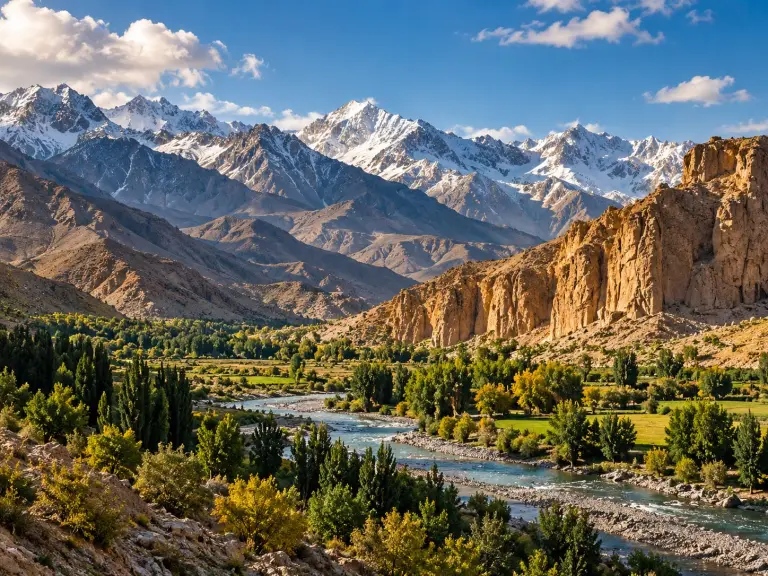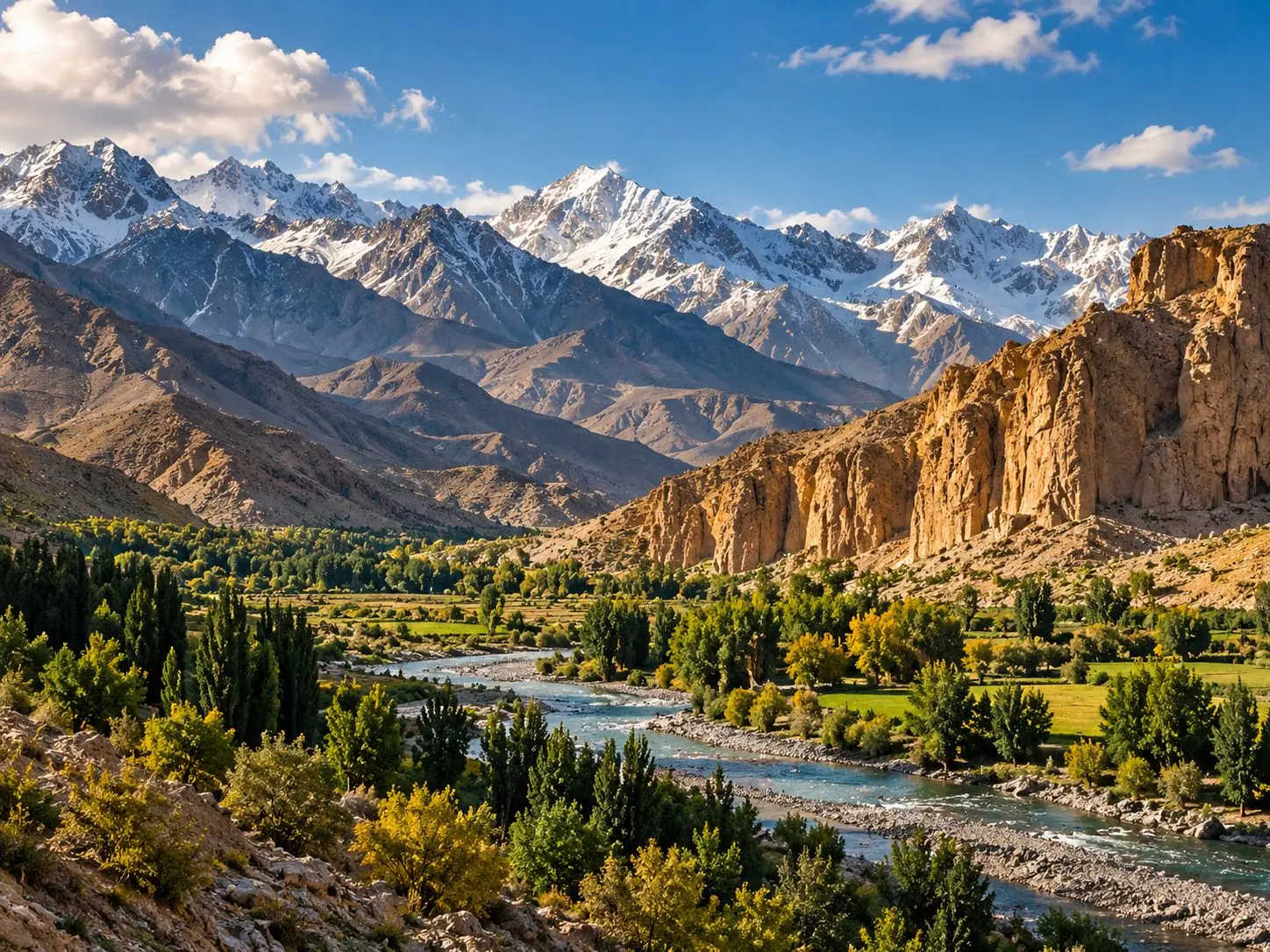
In Afghanistan’s far north-east, a long, narrow arm of land reaches eastward between the Pamir and the Hindu Kush until it touches China. This is the Wakhan, part of Badakhshan Province: a world of high valleys, glacier-fed rivers and summer pastures, stretching about 350 kilometres from Ishkashim to its eastern tip. Most of it lies above 4,000 metres, and people here call it the “Roof of the World”.
Land between the ranges
At its western entrance near Ishkashim the corridor is only about 18 kilometres wide; in central Wakhan it opens out to roughly 65 kilometres. To the north lie the Pamir River and Tajikistan, to the south the Hindu Kush and Karakoram separate it from Pakistan, and at its eastern end the Wakhjir Pass, at 4,923 metres, leads into China.
The Wakhan is a land of headwaters. The Wakhan River and the Pamir River join here to form the Panj, the upper course of the Amu Darya, the river the ancient world knew as the Oxus. The climate is severe: on the high Pamir plateaus January temperatures average about −20 °C and can fall far lower, while some sheltered valleys receive so little rain that they are true highland deserts.
Wakhi farmers and Kyrgyz herders
Two peoples make their home here. The Wakhi live in villages along the valley floor, growing crops on irrigated fields and taking their flocks to nearby high pastures in summer. They speak Wakhi, an Eastern Iranian language of the Pamir group, and like most Pamir peoples they are Ismaili Shia Muslims, a faith traditionally linked to the 11th-century poet and missionary Naser Khosrow.
Higher still, on the broad plateaus of the Big and Little Pamir, live Kyrgyz herders, Turkic-speaking Sunni Muslims who move with their yurts and animals between widely separated summer and winter pastures. The plateaus were largely empty until Kyrgyz shepherds began to settle them from the 17th century. In 1978 most of the Afghan Kyrgyz left for Pakistan and later Turkey, but Kyrgyz communities still live by the shores of Lake Chaqmaqtin in the Little Pamir.
A corridor shaped by empires
For centuries the Wakhan was a crossroads where routes from East, South and Central Asia met, and an arduous branch of the Silk Road followed the Oxus valley through it. Marco Polo noted that the people of Wakhan paid tribute to the ruler of Badakhshan.
The corridor’s present shape dates from the 1890s. Boundary agreements between Britain and Russia left this strip within Afghanistan so that the two empires, British India to the south and Russian Central Asia to the north, would not share a border. The arrangement divided the old Wakhan, and many Wakhi now live across the frontiers in Tajikistan, Pakistan and China.
Snow leopards and Marco Polo sheep
The Wakhan is home to some of Afghanistan’s most remarkable wildlife: snow leopards, lynx, brown bears, wolves, Siberian ibex and the great spiral-horned Marco Polo sheep, a favourite prey of the snow leopard. In 2014 the whole district, about 10,000 square kilometres, was declared Wakhan National Park, Afghanistan’s second national park after Band-e Amir. It was created at the request of local communities, working with the national environment agency and the Wildlife Conservation Society.