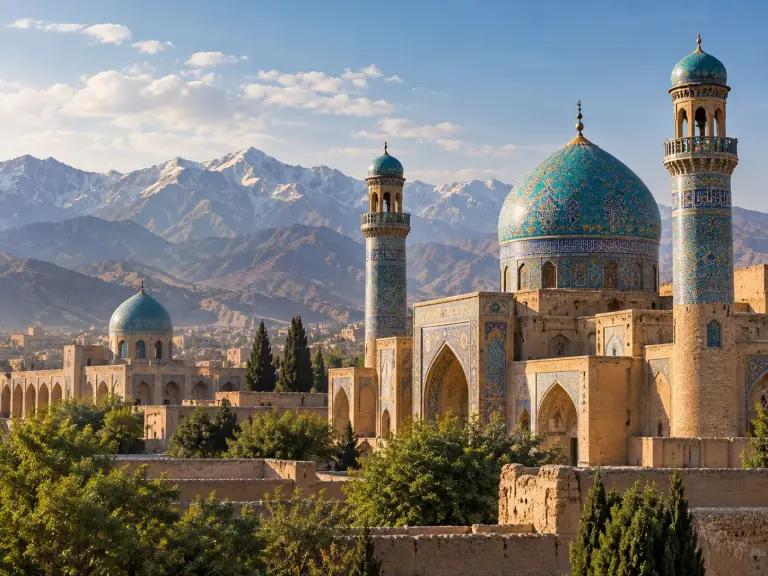
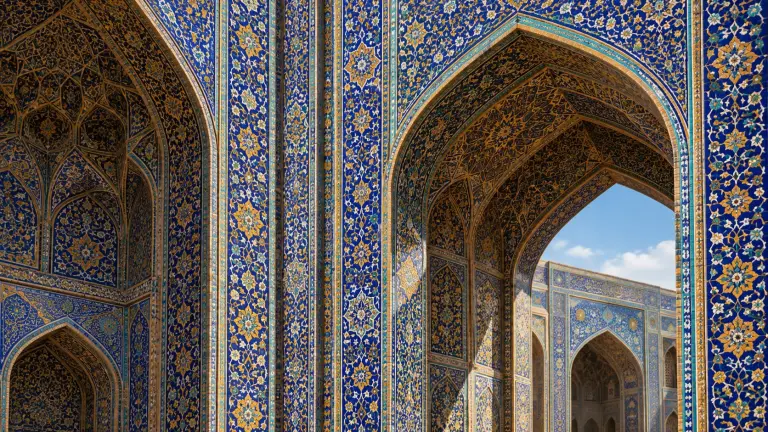
Gawhar Shad, wife of the Timurid ruler Shah Rukh, was an exceptionally powerful queen of 15th-century Central Asia and a major patron of architecture. In Herat she built the mosque and madrasa at the heart of the Musalla complex, whose tiled mausoleum and minarets still rise over the city, and at Mashhad she founded the great mosque that bears her name.
A Timurid queen
Gawhar Shad was the daughter of Ghiyath al-Din Tarkhan, a ranking amir under Timur. She married Shah Rukh, who ruled the Timurid empire from Herat from 1409 to 1447, and bore him three daughters and three sons, among them the astronomer-prince Ulugh Beg and the art patron Baysonghor.
Although she ranked below Shah Rukh’s Chinggisid wife, she was closer to him and more active in politics. She appeared prominently at weddings, funerals and religious festivals, had close ties with many amirs, among them her own brothers, and had influence in the administration of her son Baysonghor.
Builder of Herat and Mashhad
Her great mosque at the shrine in Mashhad was completed in 1418 and supported by an endowment she set up in 1426; Baysonghor himself drew the calligraphy for its tiled inscriptions. In Herat she built a madrasa and mosque complex between 1417 and 1437–38, designed by Qavam al-Din Shirazi, the most famous architect of the time. The madrasa became the mausoleum of Shah Rukh’s line.
UNESCO describes the Musalla complex as perhaps the largest historic architectural ensemble surviving in the region. Her mausoleum keeps its ribbed tiled dome above a tall decorated drum, and inside, amid painted and stucco ornament, lie the tombstones of the queen, her son Baysonghor and other family members. A single badly damaged minaret survives from the entrance of the madrasa, and it has been the focus of stabilisation work.
Power and a tragic end
When Shah Rukh fell ill in 1444–45, she promoted her grandson Ala al-Dawla as heir, causing resentment among other princes. After Shah Rukh’s death in 1447 she took the first steps to maintain order, was briefly imprisoned by another grandson, Abd al-Latif, and remained an active force in the succession struggles that followed.
Earlier in 1457, as rival princes contested Herat, she put a judge in charge of the city’s defence, and it passed without resistance to Ala al-Dawla’s son Ibrahim. Weeks later the Timurid Sultan Abu Said captured Herat. Told that she was passing information to a rival prince, he had her executed on 31 July 1457. Most Timurid historians wrote of her with respect and condemned her execution, and her buildings remain her most visible legacy.