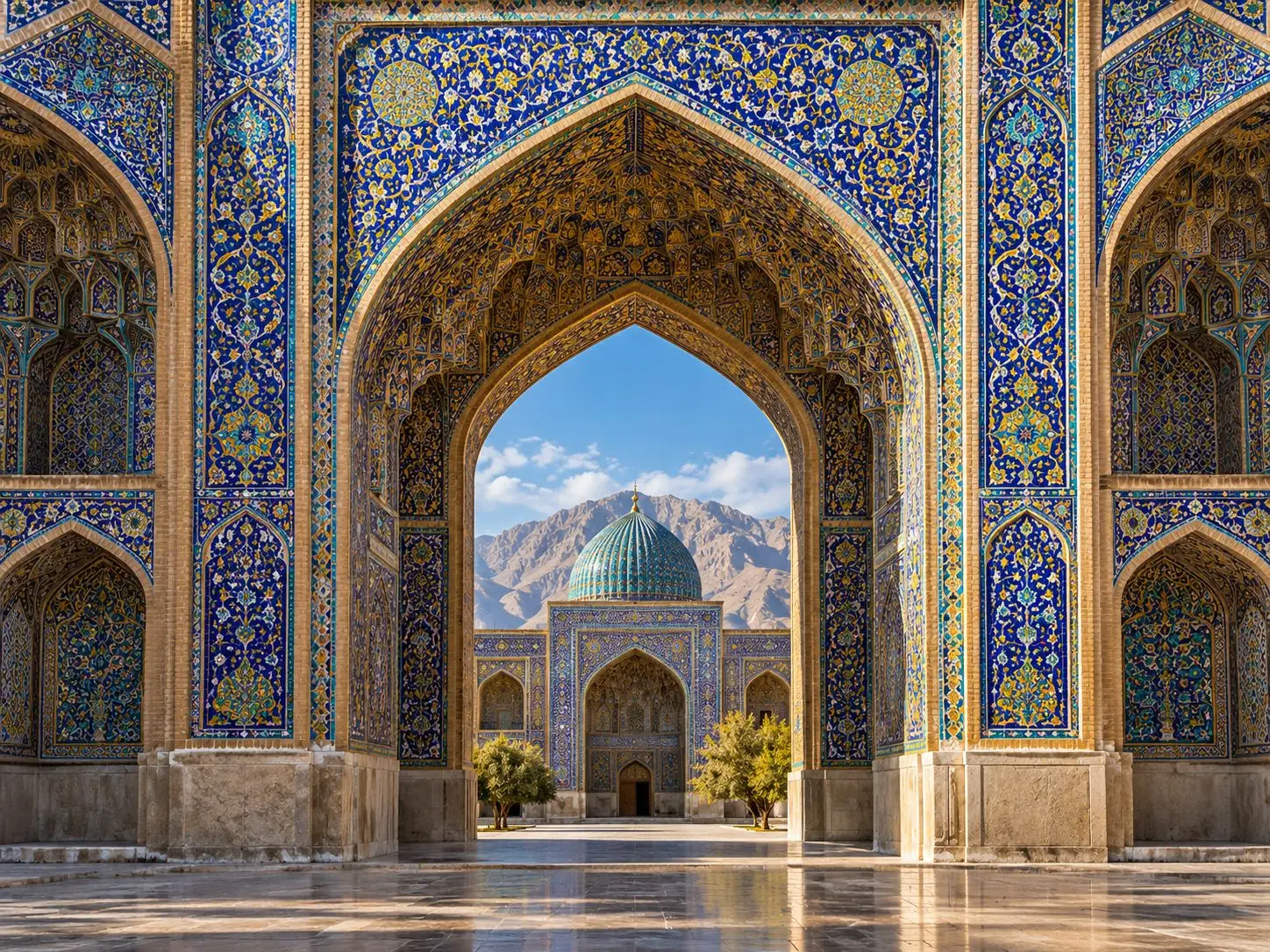
From the 7th century, Arab armies brought Islam into the lands of present-day Afghanistan. Between the late 10th and early 13th centuries two dynasties based here, the Ghaznavids of Ghazni and the Ghurids of Ghor, built empires reaching into Iran and India. Their courts patronised Persian poetry and history, and the Ghurids left one of the region’s great monuments, the Minaret of Jam.
The coming of Islam
Arab armies appeared in Khorasan in the 650s. Herat, then one of the main towns of the Sasanian empire, submitted under a treaty that also covered the districts of Badghis and Bushanj, though it rebelled and had to be retaken several times. Conversion was gradual: the mountain land of Ghor was still a non-Muslim enclave in the early 11th century.
By the 10th century, geographers described Herat as a prosperous walled town with a citadel, a congregational mosque and four gates, each opening onto a busy market. Much of the region then lay within the Samanid realm.
The Ghaznavids (977–1186)
In the 960s Alptigin, a Turkish general of the Samanid army, withdrew to Ghazni, and a series of commanders ruled there in the Samanids’ name. One of them, Sebüktigin, governed for twenty years until 997. His son Mahmud then took control of the former Samanid lands south of the Amu Darya, covering Khorasan and what is now Afghanistan, and in a reign of more than three decades built a vast empire reaching deep into northern India and west into Iran.
The sultans were Turkish in origin, but their administration was run by Persian officials in the Samanid tradition, and their court became thoroughly Persian in culture. Ferdowsi sought Mahmud’s patronage late in life; Onsori, Farrokhi and Manuchehri wrote for Mahmud and his son Masud I; later poets of the dynasty included Sanai and Masud-e Sad-e Salman. The pages of the historian Bayhaqi show Masud I as a skilled writer of Persian chancery prose.
Some Ghaznavid buildings survive: at Ghazni, the tomb of Sebüktigin, the minarets of Masud III and Bahramshah, and a palace of Masud III whose courtyard was lined with marble panels carrying Persian verse; near Bost on the Helmand, the palaces and camps of Lashkari Bazar, where fragments of wall paintings show the sultans’ guards.
The Ghurids and the Minaret of Jam
The Ghurids began as local chiefs in Ghor, in the mountainous heart of today’s Afghanistan; Ghaznavid raids in the early 11th century brought Islam and loose vassalage. In the mid-12th century Ala al-Din Husayn sacked Ghazni and Bost, earning the name Jahansuz, ‘world-burner’. Under the brothers Ghiyath al-Din at Firuzkuh and Muizz al-Din at Ghazni, Ghurid power stretched from Khorasan into northern India, until the Khwarazmshahs overwhelmed it in the early 13th century, on the eve of the Mongol invasions.
The Minaret of Jam, a UNESCO World Heritage Site since 2002, rises 65 metres beside the Hari Rud where it meets the Jam river, about 215 km east of Herat and 1,900 metres above sea level. Built of fired brick on an octagonal base, its four tapering shafts are covered in geometric relief and a Kufic inscription in turquoise tiles; UNESCO dates it to 1194, in the reign of Ghiyath al-Din. It probably marks the site of Firuzkuh, the Ghurid summer capital, and nearby stones on Kushkak hill carry Hebrew inscriptions of the 11th–12th centuries.
UNESCO also notes the minaret’s influence on later architecture as far as Delhi, where the Qutb Minar was begun in 1202. In Herat, a Ghurid portal with tiled calligraphy still survives at the Friday Mosque.