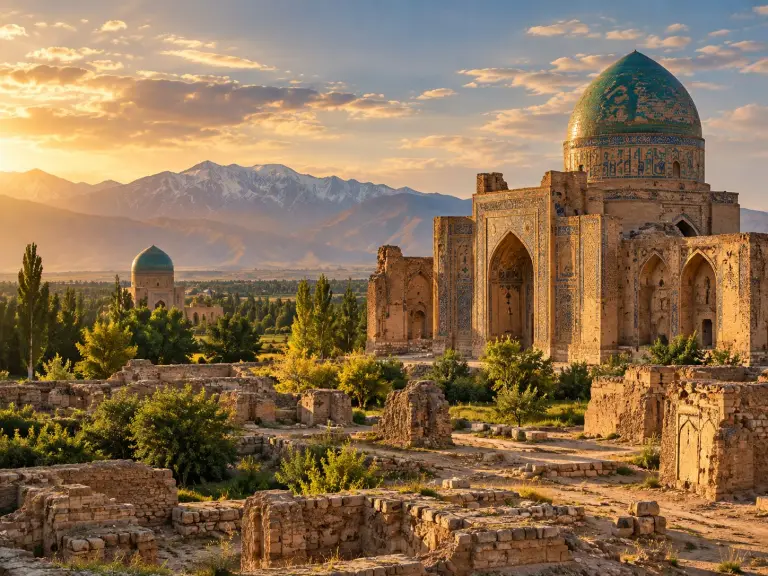
After Alexander of Macedon’s campaigns in Central Asia in 329–327 BCE, Greek settlers stayed on in Bactria, the plain between the Hindu Kush and the Amu Darya. Around 250 BCE the province broke away to form an independent kingdom, which lasted until nomad invasions about a century later. Its best-known city, Ai-Khanoum in today’s Takhar province, set a Greek theatre and gymnasium beside palaces and temples of Central Asian design.
A kingdom of its own
Bactria first belonged to the Seleucid empire, founded by one of Alexander’s generals. As Seleucid power weakened in the mid-3rd century BCE, a governor named Diodotus declared independence; coins minted at Bactra replaced the Seleucid king’s portrait with his own. Scholars still debate the exact date, with estimates between about 255 and 246 BCE.
In 208 BCE the Seleucid king Antiochus III marched in and besieged King Euthydemus in Bactra. After two years he gave up, recognised Bactria’s independence and made an alliance. Around 190 BCE Demetrius I led armies south of the Hindu Kush, founding a Greek kingdom in north-western India that outlived its parent state.
Ai-Khanoum, the city on the Oxus
The remains of Ai-Khanoum, a local Uzbek name meaning ‘Lady Moon hill’, were discovered in 1964 where the Amu Darya meets the Kokcha river. French archaeologists excavated there from 1965 to 1978. The roughly triangular city, about 1.8 by 1.6 kilometres, had mud-brick ramparts, an acropolis on a hill and a lower town holding most of its buildings.
Its public buildings were Greek in type: a huge gymnasium with courts for exercise and study, a mud-brick theatre with tiered seats, a fountain whose spouts were carved as a dolphin, a dog and a comic mask, and columns in Corinthian and Doric styles. In the shrine of Kineas, perhaps the city’s founder, a stone carried a copy of the famous maxims of Delphi. A 2017 study argues that the philosopher Clearchus of Soli set up that text in the early 3rd century BCE.
Greek and Central Asian together
Ai-Khanoum was not simply a Greek town transplanted east. Its central palace, with courtyards, offices and a treasury, followed Iranian ideas of layout; its temples had no Greek plan and recall Iranian and Mesopotamian models; and its grand houses differed from Greek homes. Its pottery mixed Greek and local forms.
The palace treasury held storage jars with Greek inscriptions, fragments of Greek literary papyri and quantities of cut and uncut stones, especially lapis lazuli; the city’s mountainous hinterland, Badakhshan, was rich in rubies and lapis. Workshops made carved ivory, inlaid stone vessels and life-size statues in clay and stucco, a technique that later spread across Central Asia. The kingdom’s silver coins are counted among the finest of Greek coinage, and the geographer Strabo remembered the land as ‘Bactria of the thousand towns’.
The end of Greek rule
In the kingdom’s last decades, King Eucratides seized power from the line of Euthydemus, and long wars between rival Greek kings weakened the state. Around 147–145 BCE Ai-Khanoum was abandoned by its Greek population and pillaged. When the Chinese envoy Zhang Qian passed through in about 130 BCE, Bactria was a patchwork of small principalities under the Yuezhi, nomads from the north from whom the Kushan empire later arose.