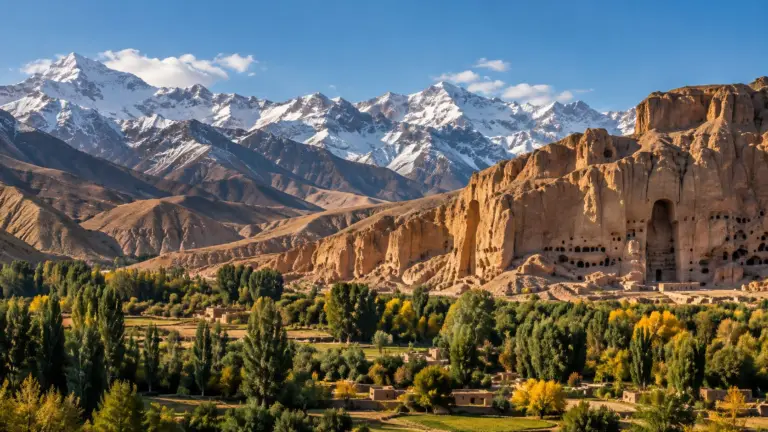
High in the mountains west of Bamyan, a chain of lakes of startling blue lies among pale, almost white cliffs. Band-e Amir sits at about 2,900 metres, some 90 km west of Bamyan town, where small rivers at the head of the Balkhab are held back by natural walls of travertine. Long admired by Afghans and visitors alike, the lakes became the heart of Afghanistan’s first national park in 2009.
Dams built by water
The lakes lie in beds of clay and limestone. Where the streams drop sharply and calm water turns turbulent, dissolved calcium settles out as travertine, building up natural dams. Living organisms, including algae and mosses, play an essential part in this process; geologists have found no sign of hot springs. The dams formed during warmer interglacial periods and are still growing today, while the outflowing water cuts steep channels through them.
Geographers count eight main basins, from a dry lake bed and shallow pools to large lakes tens of metres deep; one reaches 28 metres. Six deep blue lakes are usually named. Travertine systems of this kind exist in only a few places in the world, and Band-e Amir has been on Afghanistan’s Tentative List for World Heritage since 2004.
The legend of Ali
The dams look so unlikely that people have long believed them to be miraculous. Local tradition says they were made by Ali, the son-in-law of the Prophet, and each lake carries a name from the story: Band-e Zulfiqar, after Ali’s sword; Band-e Pudina, the lake of wild mint; Band-e Panir, of cheese; Band-e Haibat; Band-e Qambar, after Ali’s servant Qambar; and Band-e Gholaman, the lake of the slaves.
The legend survives in two closely similar versions. One scholar has suggested that it may be an old story explaining how the rivers of the Hindu Kush were brought under control for irrigation. A small shrine in Ali’s honour was built beside the lakes in the early 20th century. Hazara villagers of the district fish in the lakes and use the cascades to turn their water mills.
Afghanistan’s first national park
After a motor road from Bamyan and a small hotel were built, the lakes drew many visitors from the 1950s to the 1970s. In 2009 Afghanistan’s National Environmental Protection Agency declared Band-e Amir the country’s first national park, with funding from USAID and support from the Wildlife Conservation Society, which surveyed the area, drew up its management plan and helped train rangers. A protected-area committee brings together representatives of 13 villages inside the park.
The surrounding mountains shelter ibex, urial wild sheep, wolves and foxes, as well as the Afghan snow finch, a bird found only in Afghanistan. Snow leopards once roamed here too but disappeared in the 1980s because of hunting.