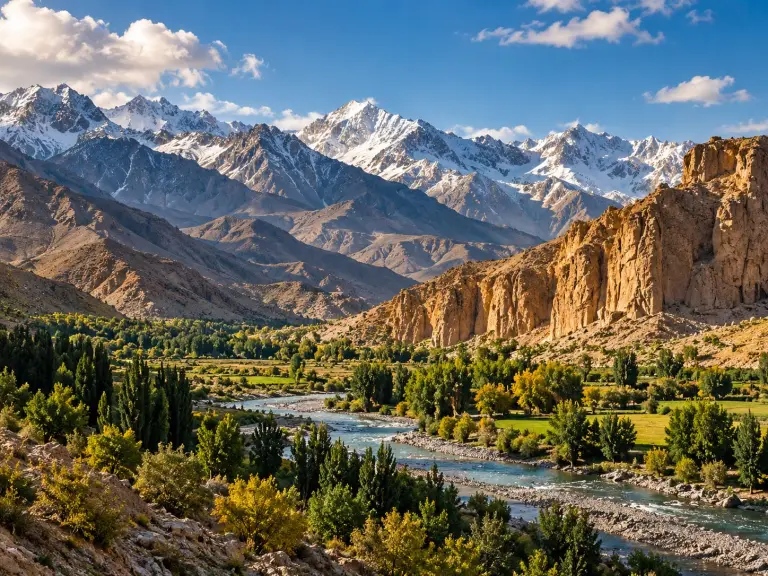
Badakhshan fills Afghanistan’s far north-eastern corner, where the Hindu Kush meets the Pamir and the land climbs into some of the highest country in Asia. Its heart is the upper valley of the Amu Darya, known here as the Panj, together with the long basin of the Kokcha river, and from its eastern edge the narrow Wakhan corridor runs on to the Chinese frontier. For thousands of years the province has been famous for one deep-blue stone: lapis lazuli.
Mountains, rivers and seasons
Much of the Pamir side lies between 3,000 and 4,000 metres, with ice-capped massifs rising far above; on the frontier with Pakistan, Noshaq in the Hindu Kush reaches 7,485 metres. The Kokcha, the chief left-bank tributary of the upper Amu Darya, drains the western valleys, while steep passes such as the Anjuman (about 4,400 m) lead south towards Panjshir.
Climate changes sharply with height. The Pamir plateaus have long, bitter winters, but Fayzabad, the provincial capital at about 1,200 metres on the Kokcha, averages close to freezing in January and about 26 °C in July. Between the warm valley floors and the cold uplands runs a belt of juniper woodland, much of it cut long ago. Summer pastures around Lake Shiva, at about 3,400 metres, draw herders from far away.
Lapis lazuli and the old trade
The lapis mines of Sar-e Sang, in the upper Kokcha valley, are counted among the oldest mining sites on earth; geologists estimate that people have worked them for some 10,000 years. Badakhshan stone travelled as far as Egypt — the lapis inlays of Tutankhamun’s golden mask have been traced to Sar-e Sang — and medieval Arab geographers described the region as a mountain land of lapis, rock crystal and “balas” rubies, a word itself derived from the region’s name.
Fayzabad was founded in 1680 by Mir Yar Beg, who moved his capital a few kilometres up the Kokcha. The town took its name, roughly “place of blessing”, after a shrine was built there to house a cloak believed to have belonged to the Prophet. The relic stayed until Ahmad Shah Durrani took Badakhshan in 1768 and carried it to Kandahar.
Peoples, languages and orchards
Encyclopaedia Iranica calls Badakhshan “a veritable ethno-linguistic museum.” Persian-speaking Tajiks form the great majority, but valleys near the Amu Darya keep older East Iranian tongues alive: Wakhi in the Wakhan, Ishkashimi, Sanglechi and Zebaki near the river’s bend, and Munji in the upper Kokcha. Many of these communities are Ismaili Muslims who trace their faith to the eleventh-century poet Nasir Khusraw. Uzbeks settled the lower western valleys from the sixteenth century, and Kyrgyz herders came to graze the high Pamir.
Most families farm terraced, irrigated fields in the valleys and take their flocks to nearby summer pastures. Orchards matter too: walnuts are a speciality of Shahada, Wardooj, Yamgan and Shighnan, and mulberries grow well around Kishim and Jurm.