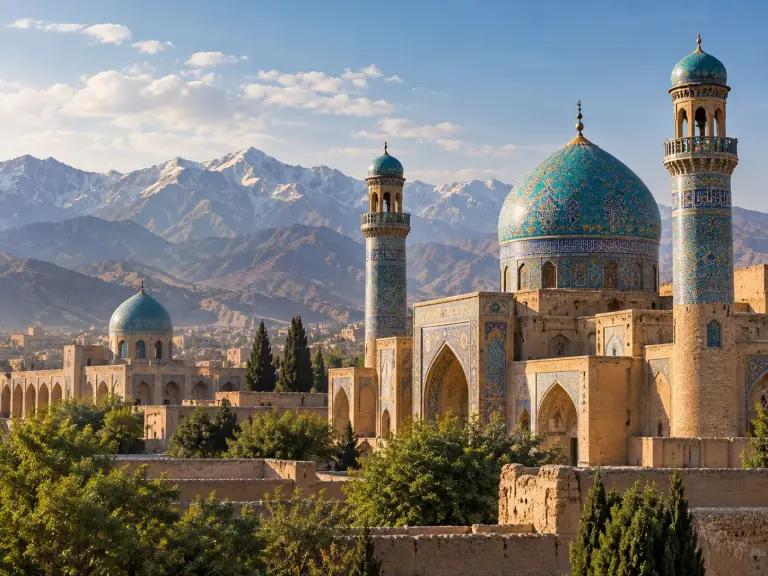
Kamal al-Din Behzad was the celebrated master painter of Timurid Herat, active at the court of Sultan Husayn Bayqara (r. 1470–1506). His name became a byword for artistic skill across the Persian-speaking world. In the few works securely attributed to him, carefully balanced compositions, clear space and expressive figures brought new life to the art of the illustrated manuscript.
An orphan of Herat
No contemporary wrote a full biography of Behzad, so his life must be pieced together from historians such as Khwandamir, the Mughal emperor Babur and later Safavid writers. He was probably born between about 1455 and 1460; according to one Safavid author he was orphaned young and brought up and trained by Mirak Naqqash, a painter and calligrapher who directed the royal workshop.
Behzad worked first for the poet and statesman Mir Ali-Shir Navai and then for Sultan Husayn Bayqara, in both cases alongside Mirak. Some accounts say that in 1486 he succeeded Mirak as head of the royal kitabkhana, the library and workshop that produced the court’s illustrated books; the Herat sources themselves present him as one of several leading painters of the day.
Painting the everyday
His key surviving work is a copy of Sadi’s Bustan made for Husayn Bayqara’s library in 1488, now in the National Library of Egypt in Cairo. Its double-page frontispiece and four paintings hide Behzad’s signature in architectural inscriptions or on small objects. The pictures are admired for their unusual clarity of space and for figures that convey mood and personality.
Behzad and his circle set scenes of ordinary life beside formal court scenes. Babur, a keen critic, admired his work but thought his beardless faces less successful. Paintings linked to him appear in manuscripts now in New York, Oxford, Manchester and London, including copies of Nizami’s Khamsa in the British Library, though many attributions are still debated.
Tabriz and lasting fame
After Husayn Bayqara’s death in 1506, Babur links Behzad with the Uzbek ruler Muhammad Shaybani Khan, who held Herat from 1507 to 1510. Behzad probably spent his last years in Tabriz at the Safavid court of Shah Tahmasp. A decree dated 1522 naming him head of the royal library there is often cited, though its authenticity has been questioned. He died around 1535–36 and was buried in Tabriz.
His fame grew after his death. Safavid writers compared him to Mani, the legendary model of the painter in Persian literature, and collectors sought his paintings for their albums. Through relatives and pupils who trained in Tabriz, the refined Herat style he represented passed into Safavid art.