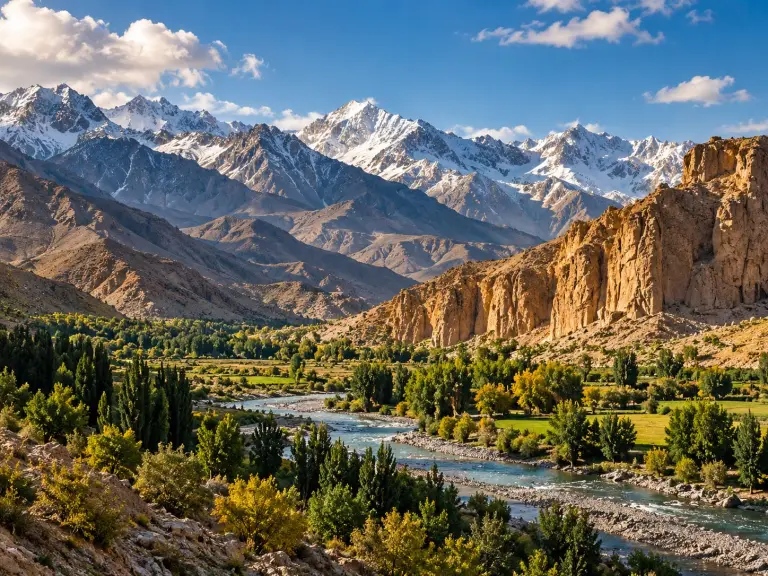
Faizabad, the capital of Badakhshan Province, stands on a narrow terrace on the right bank of the Kokcha River, about 1,200 metres above sea level, at the head of a small basin in the river’s middle valley. Its name, a favourite across the Persian-speaking world, means roughly “abode of blessing”. For centuries caravans crossing the high mountains of the north-east converged here, and the town remains the natural gateway to the Pamirs and to the lapis lazuli valleys of the upper Kokcha.
Where the caravan routes met
Faizabad’s position made it a natural meeting point. Routes leading over the central Hindu Kush toward Yarkand in China and toward India, both by way of Zebak, joined here with tracks from Darwaz to the north and from the lowlands of Qataghan downstream. A road over the Sardab Pass links the town with Ishkashim on the upper Oxus, the entrance to the Wakhan.
People settled in this part of the valley long before the present town existed. About five kilometres to the west, at Khamchan, remains from the Sasanian to the Timurid periods are scattered over some 1.5 square kilometres, and a stone bridge built across the Kokcha there in 1479 still survives as a ruin.
The town of the blessed cloak
The present town was founded in 1680, when Mir Yar Beg, a Naqshbandi leader who had brought a measure of unity to southern Badakhshan, moved his capital five kilometres upstream from Khamchan. The new settlement was first called Jawzun, “the place of walnuts”. It took the name Faizabad after a shrine was built there in 1697–98 to house a cloak believed to have belonged to the Prophet Muhammad, which Mir Yar Beg had secured as it was being carried from Samarkand to India. After Ahmad Shah Durrani brought Badakhshan under his rule in 1768, the cloak was taken to Kandahar.
The town’s fortunes rose and fell. In 1829 Murad Beg of Qataghan captured Faizabad, destroyed it and moved its people away; it was rebuilt only in the 1860s. Yet it kept an unusually rich array of religious buildings, including several Friday mosques and the shrines of local saints beside the old shrine of the cloak, to which a madrasa is attached.
A mountain market
Trade has always been the town’s lifeblood. In the 1970s its bazaar stretched along a single commercial street with some 620 shops and several caravanserais. Alongside goods brought in from far away, it sold the products of the province: salt, cumin, walnuts and apricots, and handicrafts in metal, leather and cloth. During the same decade the town was the starting point for many mountaineering expeditions into the surrounding Hindu Kush.
Its climate is gentler than that of the high valleys around it, with average temperatures of about 0 °C in January and 26 °C in July, and roughly 520 millimetres of rainfall a year.
Gateway to lapis lazuli
Upstream along the Kokcha lie the mines of Sar-e Sang, the source that made Badakhshan famous. Here deep-blue lapis lazuli occurs in layers and lenses within marble, at about 2,500 to 2,600 metres. Pieces of lapis have been found in graves dated to between 7000 and 5000 BCE, and Sar-e Sang stone was used for the inlays of Tutankhamun’s golden funerary mask. Medieval geographers praised Badakhshan for its lapis and for the red spinels known as balas rubies, a name that itself comes from Badakhshan.