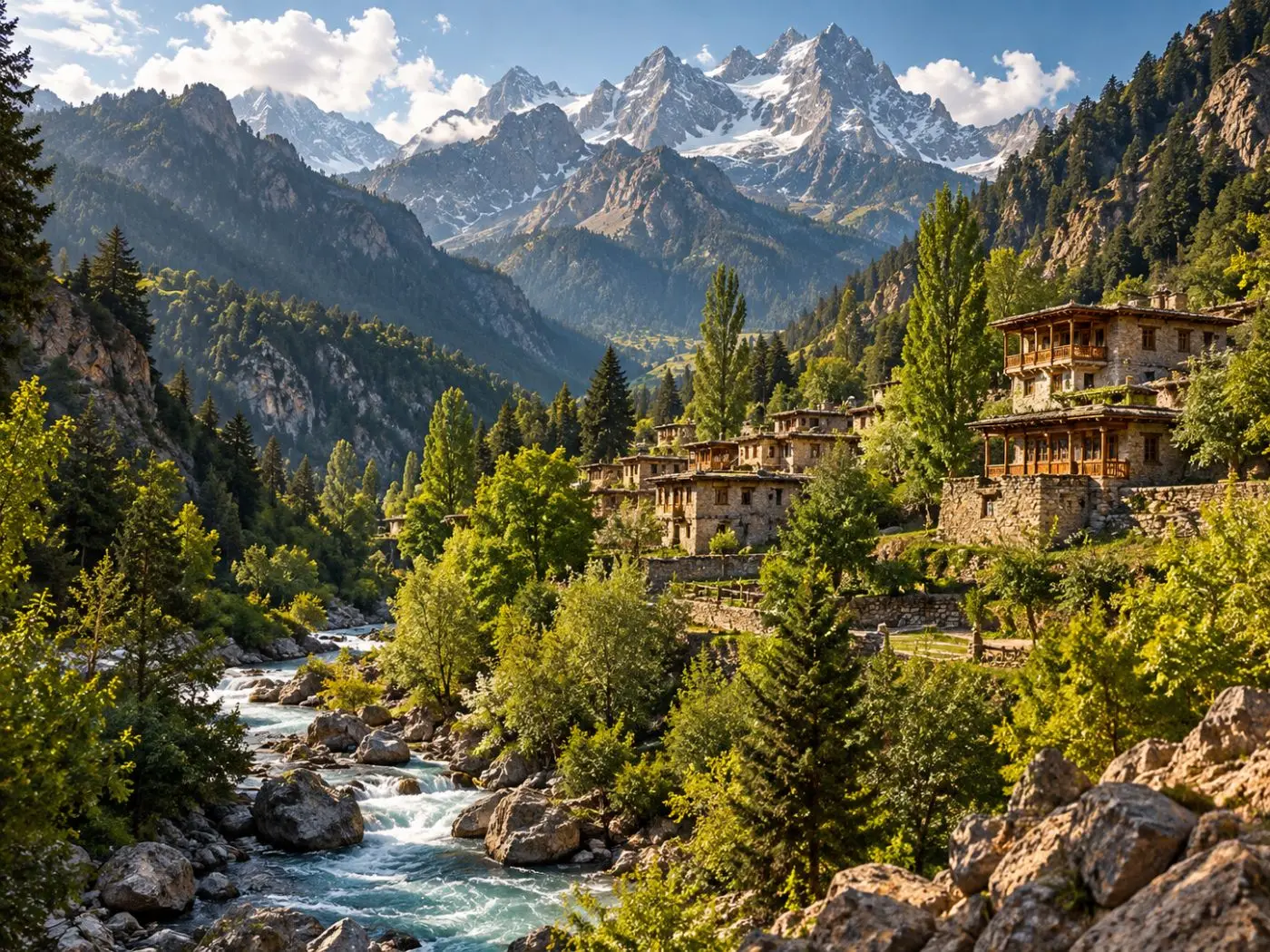
Nuristan, the “Land of Light”, lies in the steep, wooded valleys of the Hindu Kush in north-eastern Afghanistan, south of the range’s main ridge. Its rivers, the Alishing, Alingar, Pech and Bashgal, cut deep valleys beneath peaks that rise above 6,000 metres, and its slopes were once thickly forested with holly oak, pine and Himalayan cedar. Few corners of Afghanistan are as distinctive: Nuristan has its own family of languages, its own traditions of carved wooden architecture, and a history unlike that of any neighbouring region.
From Kafiristan to Nuristan
Until the end of the 19th century the region was known as Kafiristan, and its people kept an ancient, non-Islamic religion. Their survival owed much to geography: steep, forested valleys far from the great trade routes between Central Asia and India. In the winter of 1895–96 the army of Amir Abdur Rahman Khan entered the valleys, the population was converted to Islam, and the region was renamed Nuristan.
Temples and shrines with their wooden images were burned, though some carved figures were carried to Kabul; fourteen went to the Kabul Museum and four to museums in Paris. By coincidence, 1896 also saw the publication in London of George Scott Robertson’s The Kafirs of the Hindu Kush, based on his stay in the village of Kamdesh in 1890–91 and long the only eyewitness account of the old culture.
Gods, feasts and carvings
The old religion honoured many gods. A supreme deity called Imra or Mara stood above a host of lesser gods and goddesses whose names recall Vedic and old Iranian traditions, and worship centred on the sacrifice of goats and on fires of fragrant juniper. Social standing was won through great feasts of merit, and successful men displayed their rank in wood: carved house posts, throne-like chairs of honour with twin backs, tall triumphal poles and, among the Kati, life-sized ancestor figures set up near the cemeteries.
Silver wine goblets discovered in 1955 drew particular attention, because they resemble vessels shown in Central Asian wall paintings of Sogdian banquets from the 5th to the 8th centuries.
Houses of cedar
Nuristani villages climb the hillsides in steps, sparing the scarce flat land for fields. The large villages, among them Kamdesh, Waigal and Wama, have 300 to 500 houses each. Houses are usually square, single-room buildings with cellars, raised on a timber frame of interlocking, scaffold-like beams that helps them withstand earthquakes. The best construction wood came from the Himalayan cedar.
Life follows the seasons. Men tend the livestock, mainly goats, which in winter are fed on the leaves of holly oak, while cattle dominate in the higher valleys. Each summer the men take the herds up to high meadows rich in milk, butter and cheese, and women cultivate tiny terraced fields in the valleys below.
Languages of the valleys
Nuristan is the homeland of a unique group of Indo-European peoples. Four main languages are spoken: Kati, the most widespread, in the north-west and north-east; Waigali and Ashkun in the south; and Prasun, or Vasi, in the Parun valley. Linguists class them as an ancient branch of the Indo-Iranian family, and the American linguist Richard Strand has spent decades recording their sounds, grammar and vocabulary.
The mountains also hold mineral treasures. Pegmatite veins in the Nuristan region have yielded green, blue and pink tourmaline, kunzite and aquamarine, and Soviet geologists first studied these gem deposits in the early 1970s.