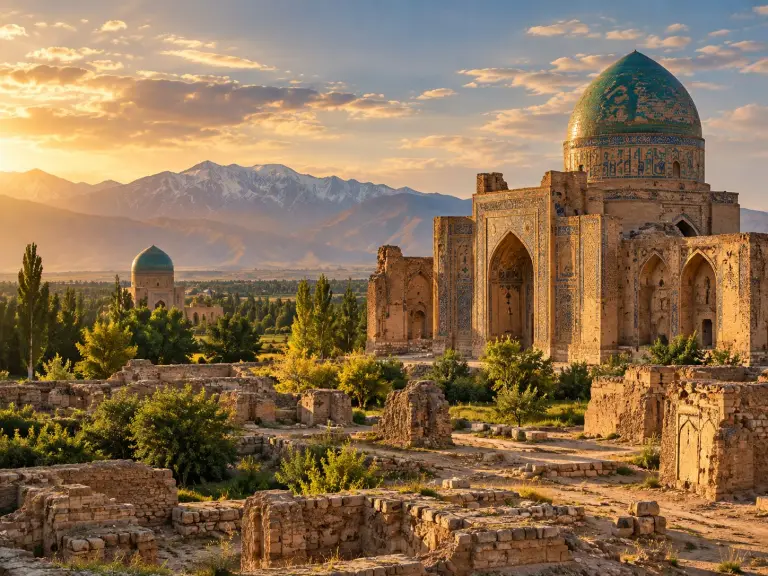
Jalal al-Din Muhammad Balkhi, known in Afghanistan and Iran as Mawlana and in the West as Rumi, is a Persian poet and Sufi thinker whose work is read and recited far beyond the Persian-speaking world. Born in 1207 in the Balkh region, he left with his family as a child and spent most of his life in Konya, in today’s Turkey. There he composed the Masnavi, a vast mystical poem, and lyrics that are still sung and recited around the world.
From Balkh to Konya
His father, Baha al-Din Walad, was a theologian, preacher and mystic. Rumi was born on 30 September 1207. Tradition, followed by UNESCO, names Balkh as his birthplace; some modern scholars argue that the family was then living at Vakhsh, a smaller town of the same region, now in Tajikistan. In Afghanistan he is known as Mawlana Jalal al-Din Balkhi.
Around the time of the Mongol invasions, about 1215–1220, the family set out west. Their journey took them through Nishapur, where legend says the boy met the poet Attar, and on to Baghdad, Mecca and Damascus. They settled in Konya around 1228, and Rumi later took over the madrasa where his father had taught.
Shams of Tabriz
In November 1244 Rumi, by then a respected scholar and jurist, met the wandering dervish Shams of Tabriz. The encounter transformed his life, turning him towards ecstatic mysticism and poetry. After Shams disappeared in 1248, Rumi poured his longing into a great body of lyric verse, gathered as the Divan-e Shams, named for his friend.
The Masnavi
The Masnavi, a didactic poem of some 26,000 verses, was dictated over many years to his deputy Husam al-Din Chalabi for a circle of disciples who already loved the mystical poems of Attar. It moves rapidly between stories, sermons and direct address to the reader, and cites the Quran and Hadith far more often than other poems of its kind.
Its best-known teaching story, Moses and the Shepherd, shows God rebuking Moses for scolding a simple shepherd’s prayer: what matters, the tale suggests, is the worshipper’s inner state, not outward form. At its climax Rumi declares that the lovers of God stand apart from every creed. His prose talks were also collected, as Fihi ma fihi.
A lasting legacy
Rumi died in Konya on 17 December 1273. His followers founded the Mevlevi Sufi order there, known for the sema ceremony of the ‘whirling dervishes’, which UNESCO lists as intangible cultural heritage. In 2007 UNESCO marked the 800th anniversary of his birth with a demonstration of Sufi dance, an exhibition of manuscripts, a scholarly seminar and a commemorative medal named for Mawlana Jalal al-Din Balkhi-Rumi.
His work has been translated into many languages, with especially rich traditions of translation and commentary in English and Turkish.