In the 15th century Herat became the capital of the Timurid empire and a centre of art and learning. Under Timur’s son Shah Rukh and his wife Gawhar Shad, and later under Sultan Husayn Bayqara, rulers and nobles poured wealth into mosques, colleges and gardens, and into the arts of the book: calligraphy, painting, illumination and binding.
Herat becomes a capital
Herat had been rebuilt after the Mongol invasions by the local Kart dynasty (1245–1389). Timur brought Khorasan under his rule and in 1397 named his youngest son, Shah Rukh, governor of Herat. After Timur’s death in 1405, Shah Rukh made himself master of the whole Timurid state and ruled from Herat until 1447, over lands reaching as far west as central Iran.
His reign brought intense royal patronage, new building and the growth of trade, including the restoration and enlargement of Herat’s bazaar. Shah Rukh also commissioned tilework on the towers of the citadel, today’s Qala-i Ikhtyaruddin, some of which can still be seen.
Gawhar Shad’s Musalla
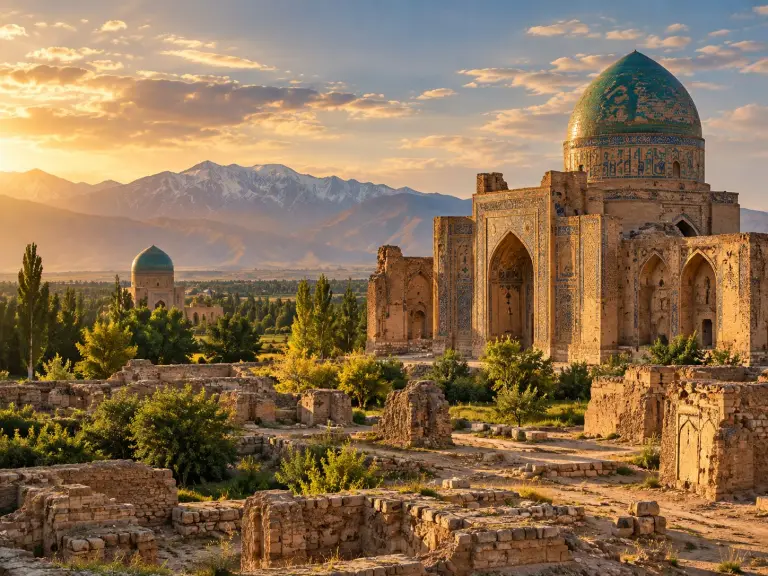
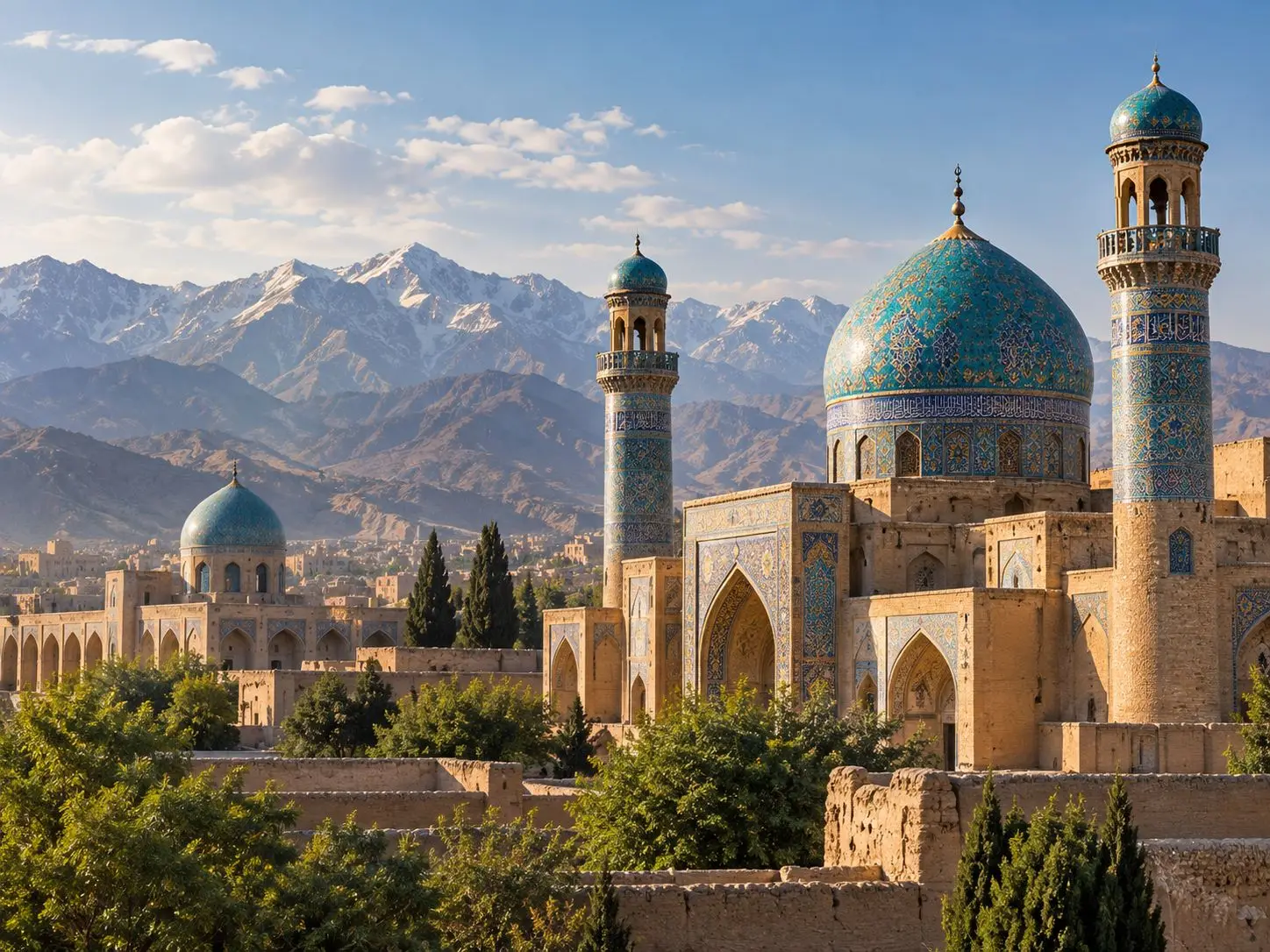
Shah Rukh’s wife Gawhar Shad was a major patron of architecture. Between 1417 and 1437–38 she built a mosque and madrasa complex in Herat, designed by the celebrated architect Qavam al-Din Shirazi, and she also founded the great mosque at Mashhad, completed in 1418. Her mausoleum, with its ribbed tiled dome above a decorated drum, still stands among the surviving minarets of the Musalla complex.
A school of the book
Their son Baysonghor (1397–1433), himself a first-class calligrapher, made Herat a centre of the book arts. In 1420 he brought the leading master of nastaliq script, Jafar Tabrizi, and other experts from Tabriz. The Herat workshop that grew up under Shah Rukh and Baysonghor worked like an academy, with about forty artists and scholars, and developed a new style of book illustration, calligraphy, illumination and binding. A famous copy of Ferdowsi’s Shahnameh made there dates from 1429–30.
The age of Husayn Bayqara
After a period of succession struggles, Sultan Husayn Bayqara (r. 1470–1506) presided over a second flowering. Herat and its countryside prospered, and dignitaries such as the poet and statesman Mir Ali-Shir Navai endowed charitable foundations. The painter Behzad worked for Navai and for the sultan, and the shrine of the Sufi Khwaja Abdullah Ansari at Gazargah still keeps fine Timurid tilework, a late 15th-century pavilion and the black marble Haft Qalam sarcophagus from his reign.
In 1507 the Uzbek ruler Muhammad Shaybani Khan took Herat, and the Timurid age there came to an end. Behzad later worked at the Safavid court in Tabriz, carrying Herat’s style with him.