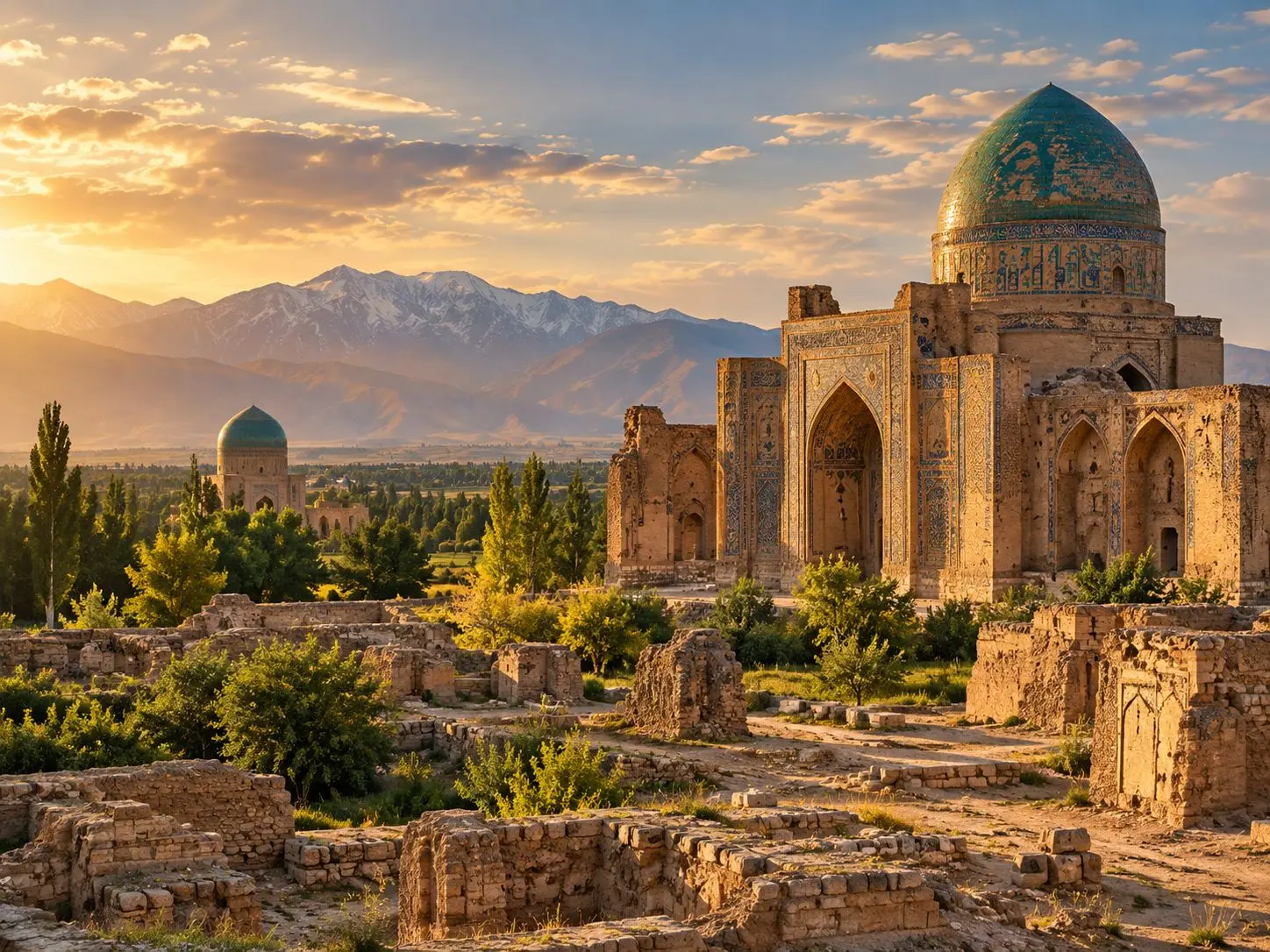
Balkh, on the plains of northern Afghanistan, was known to medieval geographers as Omm al-belad, the “mother of cities”. Its ruins cover some 11 square kilometres west of Mazar-e Sharif, and its great mud ramparts still rise more than 20 metres high at the citadel. As ancient Bactra, it gave its name to the whole region of Bactria, and over many centuries it was a centre of Zoroastrian, Buddhist and Islamic life.
Bactra, city of Bactria
Legend credits the founding of Balkh to the mythical king Kayumars, and the city is remembered as a long-standing centre of the Zoroastrian religion, with a rich temple to the goddess Anahita. Archaeology shows that its round citadel, the Bala Hissar, probably follows a plan going back to the Achaemenid period. Its Greek rampart withstood a siege by the Seleucid king Antiochus III in 208–206 BC, and a long Greek-era wall, traced for some 60 km, guarded the northern edge of the oasis against nomads.
Buddhism flourished here too. The Chinese pilgrim Xuanzang described a “New Monastery” in the 7th century, remembered in Islamic sources as the Nawbahar. Its great stupa, the Top-e Rustam, once stood on a platform 54 metres square, with a dome 47 metres across: the largest stupa recorded north of the Hindu Kush. The monastery is famous in Islamic sources because the Buddhist ancestors of the Barmakid family were its administrators.
Splendid Balkh
Arab armies reached Balkh in the 650s, and in 725 the governor Asad ibn Abdallah rebuilt the city on its old site. Geographers of the 9th and 10th centuries praised it as the greatest city of Khorasan and as Balkh al-bahiya, “splendid Balkh”, equal in size to Marv and Herat. A 9th-century mosque, known as Noh Gonbad or Haji Piyada, survives about 3 km south of the city: nine square bays, once each crowned by a dome, with carved stucco of vine scrolls, fir cones and rosettes.
Travellers in the 12th century described the city’s many schools, and its fame as a place of learning lasted. The poet Jalal al-Din Rumi was born in 1207 in the Balkh region; his family moved west before the Mongol invasion, and he spent most of his life in Anatolia. In 1220 the Mongols reached Balkh, and in the spring of 1221 the city was sacked when Chinggis Khan arrived.
Monuments that remain
Timur and his successors refortified Balkh, shifting it slightly westwards. The finest surviving building is the shrine of Khwaja Abu Nasr Parsa, built in 1462–63: a tall entrance arch flanked by minarets and a fluted dome faced in silvery-blue tiles, one of the most beautiful examples of late Timurid memorial architecture. Opposite stands the tiled entrance iwan of a madrasa built by Sayyid Subhan Quli Khan in the late 17th century, when Balkh was ruled by the heirs to the throne of Bukhara.
After it was ruined in 1840, Balkh declined, and in the second half of the 19th century the seat of regional government moved to Mazar-e Sharif. Today the old walls, stupas and shrines lie among farmland, and the city has been on Afghanistan’s Tentative List for World Heritage since 2004.