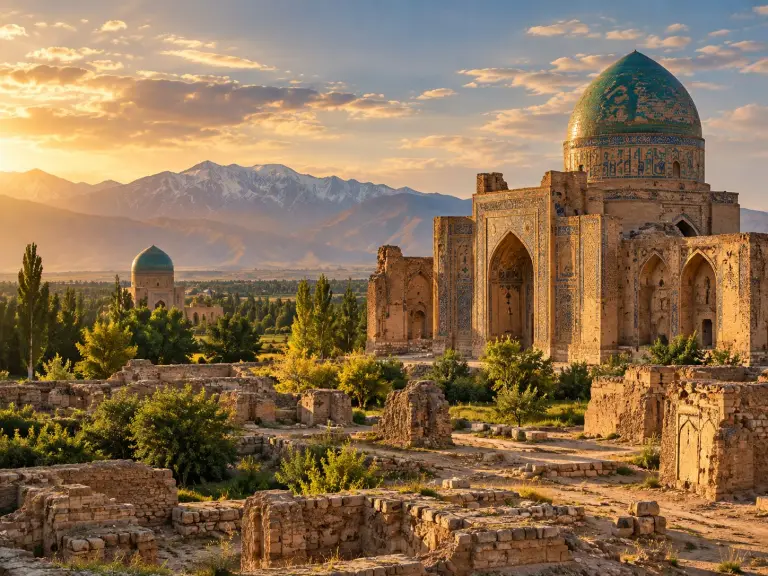
Mazar-e Sharif, “the noble tomb”, is the largest city of northern Afghanistan. It grew up on the plains north of the Hindu Kush, about 18 km east of ancient Balkh, around a shrine revered as the resting place of Ali ibn Abi Talib, the fourth caliph and cousin and son-in-law of the Prophet. The blue-tiled shrine, widely known as the Blue Mosque, is still the heart of the city and of its famous Nowruz celebrations.
A city born of a shrine
For a long time the site was a simple village called Khayr, later Khwaja Khayran, on the Nahr-e Shah, the easternmost of the canals that water the Balkh oasis. In 1135–36, in the time of the Seljuq sultan Sanjar, a mystic declared that he had learned in a revelation that Ali was buried there; where the caliph lay had long been a matter of speculation. A mausoleum was built, and as word of miraculous cures spread, it quickly became a place of pilgrimage.
That first building was probably destroyed during the Mongol invasion. The present tomb was raised in 1480–81 under the Timurid ruler Sultan Husayn, who endowed the shrine with generous income from pious endowments. From then on pilgrims came from across Central Asia, and by the 19th century the name Mazar-e Sharif had replaced all others.
From shrine town to regional centre
In the early 19th century Mazar was still a small town of a few hundred households. As Balkh declined after 1840, its canals broken and its air made unhealthy by malaria, the governors of the north moved closer to the shrine. Soon afterwards the governor Muhammad Alam (d. 1876) made Mazar his seat and laid out a rectangular square with the shrine at its centre, set in a chaharbagh garden.
Growth followed quickly. A motor road over the Shibar pass, opened in 1933, linked the city with Kabul, and Mazar became the main market of the north for cotton, wheat, karakul skins and grapes. Factories followed from the late 1950s, including the country’s first fertilizer plant at Dehdadi in 1974. The 1979 census counted about 103,000 people, and today Mazar is the regional capital of northern Afghanistan. The city stands at a meeting point of Uzbek, Tajik and Hazara communities, and its bazaars are known for striped alacha cotton and chapan coats.
Nowruz and the red tulips
Mazar is best known for Nowruz, the New Year that falls on 21 March. For forty days after it, celebrations are held in honour of Ali, and tens of thousands of pilgrims fill the city. On the first day comes the Jahenda Bala, when a great banner is raised in the courtyard of the shrine before crowds of worshippers, who then pray for a good year ahead.
The season is also called Mela-e Gul-e Surkh, the festival of red flowers, because wild red tulips bloom at this time on the hills of the Shadyan range above the city. Families share haft mewa, a mix of seven dried fruits soaked in water, and the second day honours farmers with their own festival, Jashn-e Dehqan. Nowruz is inscribed by UNESCO as intangible heritage shared by Afghanistan and its neighbours.