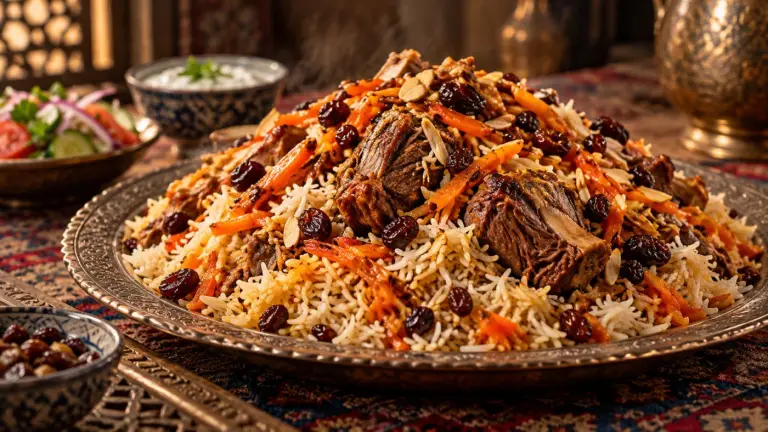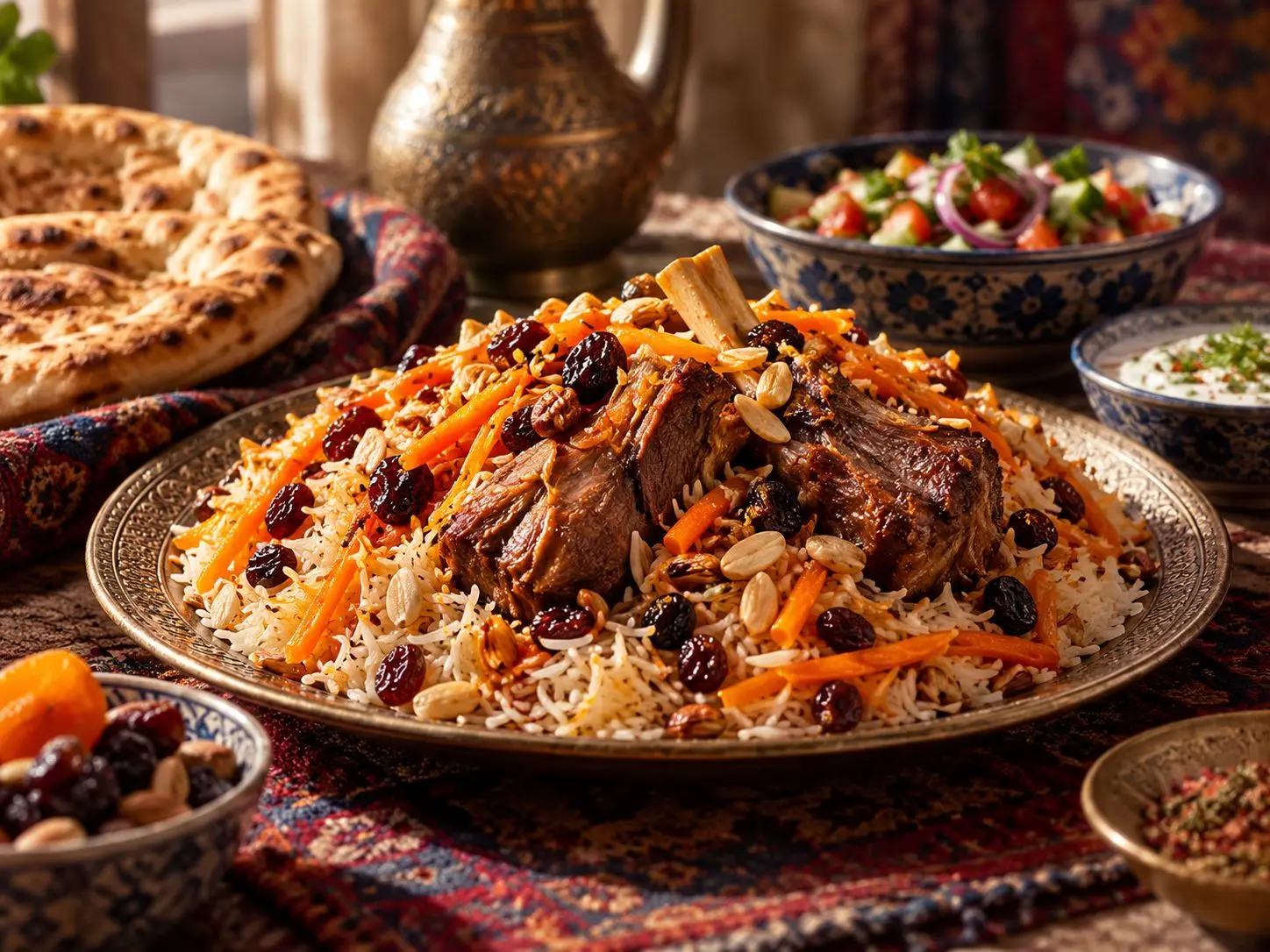
At an Afghan celebration, the dish that matters most often arrives on a single platter: a mound of long-grain rice, glossy and amber-brown, hiding tender pieces of meat and crowned with sweet threads of carrot, plump raisins and slivered nuts. This is qabili palaw, known in English as Kabuli pulao, and it is widely called Afghanistan’s national dish. Its story draws on the region’s long history of rice cookery, the old art of the pilaf, and the Afghan conviction that guests deserve the best a household can offer.
A feast built on rice
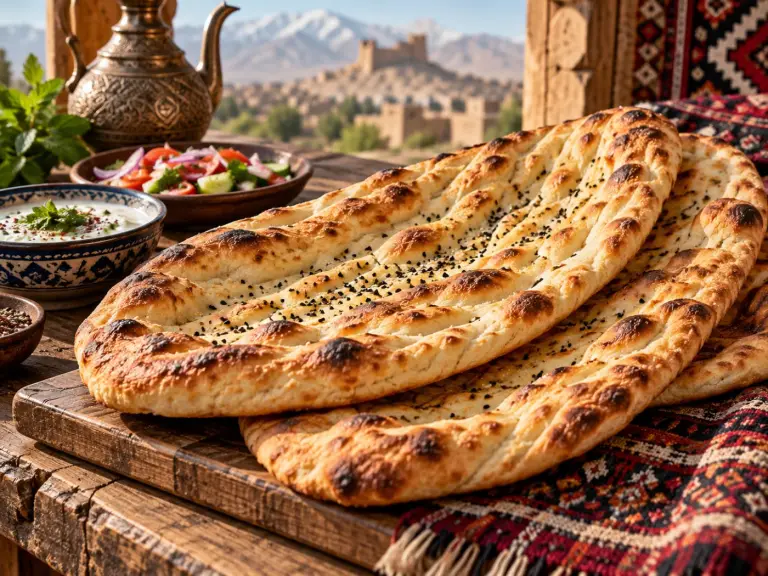
For most Afghans, everyday food has traditionally been simple: bread and plenty of sweetened tea. Feasts are different. Encyclopaedia Iranica notes that on festive occasions the main dish is usually a mounded platter of rice, and that rice cooked with large pieces of lamb or chicken (palaw) and plain boiled rice (chalaw) are especially popular. Nuts, raisins and carrots are often used as garnishes.
Behind the platter lies a culture of hospitality. Afghan cookery is bound up with that social institution, Iranica observes: a family’s honour and standing are measured in good part by the generosity of its kitchen, and every stage of life, from birth to death, as well as the turning of the seasons, is marked with feasting. Pilgrims giving thanks at shrines for prayers answered distribute large quantities of palaw to the needy, and many shrines keep enormous cooking vessels and their own cooks for exactly that purpose.
The rice itself is a matter of pride. In Afghanistan rice is a summer crop that needs constantly wet, irrigated fields at low or medium altitude, and the most valued varieties are long-grain rices, prized because the grains stay separate when cooked. These grow only below about 1,000 metres, in Qataghan in the north-east and in the lowlands between Laghman and Kunar. In Kabul’s markets, Iranica reports, long-grain rice from Laghman has commanded a slight premium, and Laghman was already supplying the Afghan court with rice at the beginning of the 19th century.
The long road of the pilaf
Pilaf is one of the great shared dishes of western and Central Asia, and its history is long. According to Iranica, the Persian word polow, pronounced palaw in Dari, is first attested in the writings of the poet Obayd Zakani, who died around 1370. The 15th-century Spanish ambassador Ruy González de Clavijo described rice dishes served at the court of Timur, and two Persian cookbooks of the Safavid era, compiled in 1520–21 and 1594–95, already give recipes for polow, though these differ from the versions cooked today.
Afghanistan’s palaws belong to a family that stretches across the region. In Tajikistan, oshi palav, inscribed by UNESCO in 2016 on its Representative List of intangible heritage, is known as the “king of meals,” and up to 200 varieties are said to exist. UNESCO describes it as a dish that brings people together at ordinary meals, celebrations and rituals. Its skills pass from master to apprentice; an apprentice who finally masters the dish hosts a dinner for the teacher and receives a skimmer, the cook’s tool, as a symbol of independence.
Within Afghanistan, too, there are variations. Uzbek cooks make a version known as Uzbeki palaw, which departs from the usual Afghan method: instead of being parboiled, drained and steamed (the sof method), the rice is cooked until it has absorbed all its liquid (the dampokht method).
What’s in a name?
In English the dish is usually called Kabuli, as if named after the capital, while in Afghanistan it is widely known as qabili. Explanations differ. One popular account, told by the Afghan-American food writer Humaira Ghilzai, holds that the dish was first made by well-to-do families of Kabul who could afford caramelised carrots, raisins and costly nuts. As it spread more widely, the name shifted from Kabuli to qabili, from the Dari word qabil, ‘accomplished’, a nod to the skill needed to balance its flavours.
Other writers argue that the dish is not named after Kabul at all and probably took shape in Afghanistan’s north, near the border with Uzbekistan. Whichever is true, the word qabil captures something every Afghan cook understands: this is a dish that reveals the hand that made it.
How the platter is built
Recipes vary from family to family, but the architecture of the dish is consistent. Onions are browned slowly until deep and dark, and the meat, lamb or chicken, is cooked in them to make a rich sauce, seasoned with spices such as cumin and cardamom. Long-grain rice is washed, often soaked, then boiled briefly until just tender, drained and mixed with the sauce, which gives the grains their characteristic brown colour.
Then comes the slow finish. The rice is steamed in a tightly covered pot so that the grains cook through without breaking; Ghilzai calls keeping the rice whole the most important part of the process. Meanwhile, carrots cut into matchsticks are softened and glazed with a little sugar, together with raisins and slivered almonds, and kept apart so that they stay bright and do not mix into the rice too early.
At the table, the meat is placed on a large platter and buried under the rice, and the carrots, raisins and nuts are scattered over the top. Iranica adds that the juice of sour oranges is used to heighten the flavour of palaw, and that pickles, chutneys and fresh salads of tomato, onion and coriander typically accompany Afghan meals.
It is a dish designed to be shared: one platter, many hands. In that sense, every time qabili palaw is carried out to the guests, it brings the whole Afghan ethic of hospitality to the table with it.