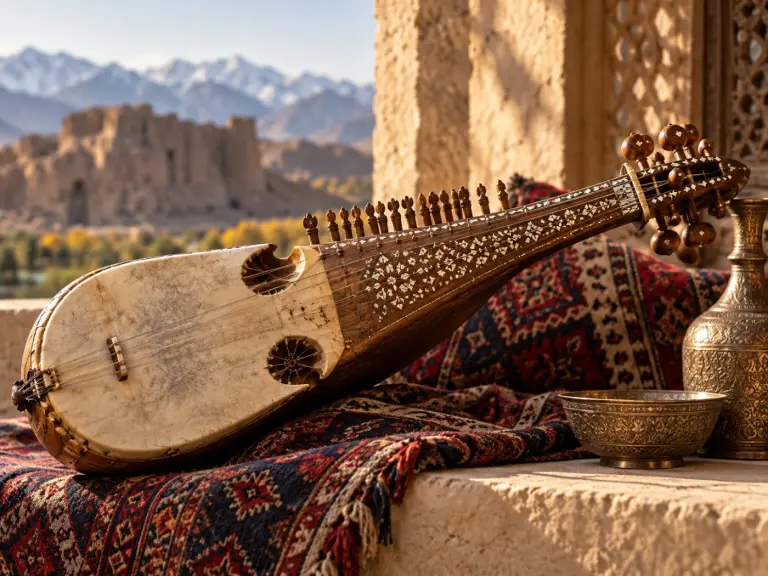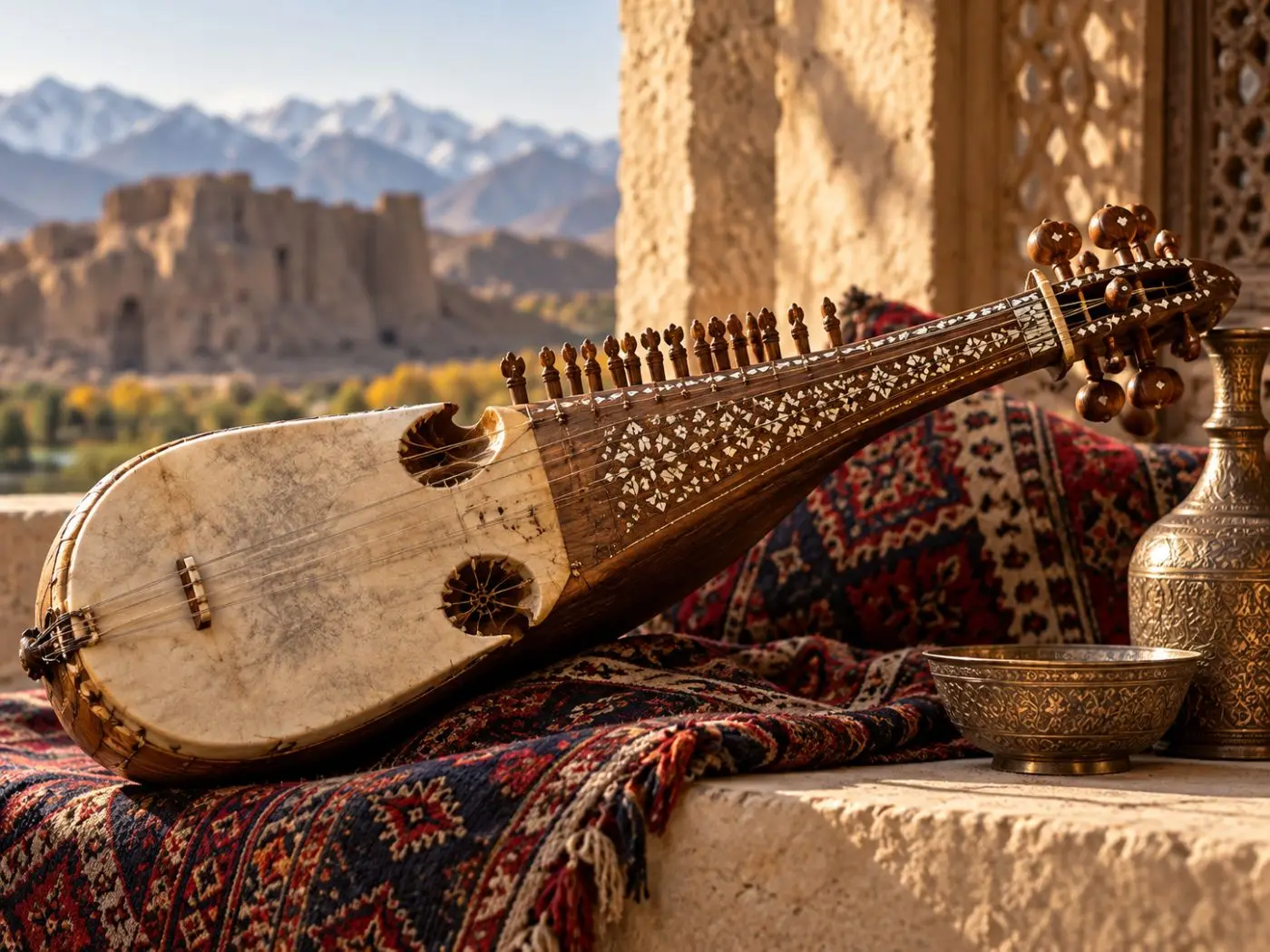
Few sounds in Afghan music are recognised as quickly as the bright, ringing attack of the rubab. Plucked with a small plectrum, its melody strings snap and sing, while a halo of finer strings beneath them rings in sympathy, so that each note seems to hang in the air. The rubab is known as the “lion of instruments,” and it is counted as one of Afghanistan’s two national instruments, alongside the zerbaghali goblet drum. In 2024, UNESCO inscribed the art of crafting and playing the rubab on its Representative List of the Intangible Cultural Heritage of Humanity, following a joint nomination by Afghanistan, Iran, Tajikistan and Uzbekistan.
Carved from a single piece of wood
The Afghan rubab is a short-necked lute. Its boat-shaped body and its neck are carved from one piece of wood, traditionally the trunk of a mulberry tree; UNESCO’s description speaks of dried mulberry wood. The body is hollowed into two sound chambers joined by a narrow, indented waist. The lower chamber is covered with goatskin, on which the bridge stands, while the upper part is closed with a wooden board.
The strings fall into three groups. Three melody strings, tuned in fourths, carry the tune, and two or three drone strings supply a steady background. Beneath the bridge run the sympathetic strings — up to fifteen on a large instrument — which lead to tuning pegs along the side of the body. The player does not pluck them for the melody; they resonate with it, giving the rubab its shimmering after-ring. An instrument about 80 centimetres long in the collection of the Tokyo University of the Arts, for example, has three nylon melody strings, two steel drone strings and thirteen steel sympathetic strings; a smaller rubab in the Hartenberger World Musical Instrument Collection has nine.
Strings may be of gut or nylon. The player sits cross-legged and holds the instrument roughly horizontally across the lap, plucking with a small wooden plectrum held in the right hand. The neck carries a few frets tied around it — four on the Tokyo instrument. Frets are one of the features that distinguish the Afghan rubab from the fretless sarod of North India, which is widely regarded as its descendant.
A craft handed down
Making a rubab is an art of its own. UNESCO describes rubab crafting as a traditional skill that brings together carpentry, woodcarving, marquetry and inlay. It is usually learned through hands-on practice, often as a family tradition. Most makers are men, but players include people of both genders and of all ages, ethnicities and religious backgrounds.
The work begins with a block of seasoned wood, which is shaped and hollowed into body and neck. The skin is then stretched over the lower chamber, the surfaces are finished and decorated, and finally the instrument is strung. Because each body is carved by hand from a single block, no two instruments are quite alike.
Playing is passed on in a similar way. The Smithsonian Folklife Festival describes how one of today’s leading players, Homayoun Sakhi, began studying the rubab with his father, Ghulam Sakhi, at the age of ten, in the traditional master–apprentice relationship known as ustad–shagird. In this system, technique, repertoire and musical taste travel directly from teacher to pupil.
Central Asian roots, a raga accent
The rubab’s family tree spans Asia. The Asia Society describes the instrument as Central Asian in origin, one of a family of double-chambered lutes that also includes the Iranian tar, the Tibetan danyen and the Pamiri rubab. UNESCO counts the rubab among the oldest musical instruments of Central, South and Southwest Asia.
The name itself is widely shared. The Hartenberger collection notes that ‘rabab’ is a term for lute-type instruments with a skin soundboard, found from Central and Southeast Asia to India, the Middle East and North Africa. Some are bowed, like the Arabic rebab from which the name comes; the Afghan rubab, by contrast, is plucked, double-chambered and quite different in construction.
Its classical music has a strong South Asian accent. In the 1860s Amir Sher Ali Khan, the ruler of Kabul, brought classically trained musicians from India to perform at his court, and some of Kabul’s leading musical families trace their lineage to that moment. The Asia Society describes the style and repertoire of one such heir, Homayoun Sakhi, as rooted in the raga tradition of North India while showing strong links to Iran and Central Asia, and it calls both the instrument and its music hybrid creations.
From wedding to concert hall
The rubab has never belonged to a single setting. UNESCO lists celebrations, weddings, funerals, social gatherings and ritual healing among the occasions at which it is played, and notes that it is also a leading instrument in orchestral and contemporary music, including multinational ensembles. Master players are respected as elders of their communities and often open particular ceremonies and rituals. Poems and literature allude to the instrument, and elders recount myths about it at gatherings.
It serves folk and classical music alike, accompanying songs and also carrying melodies of its own, according to the Tokyo University of the Arts and the Hartenberger collection.
The rubab has also travelled with Afghan communities abroad. Homayoun Sakhi, born in Kabul into one of Afghanistan’s leading musical families, settled in Fremont, California, in 2001. There he opened a school to teach Afghan music to children and became a sought-after performer. UNESCO, for its part, emphasises the rubab as a unifying bond among the peoples of Afghanistan, Iran, Tajikistan and Uzbekistan, one that has fostered cultural exchange and solidarity, especially among migrant communities.
Hold a rubab and its double-chambered body feels at once sturdy and alive: a block of mulberry turned into a voice. That transformation, repeated by makers and players across generations, is exactly what UNESCO’s listing sets out to safeguard.